Blocking Iran With A Global Game Of Nuclear 'Keep Away'
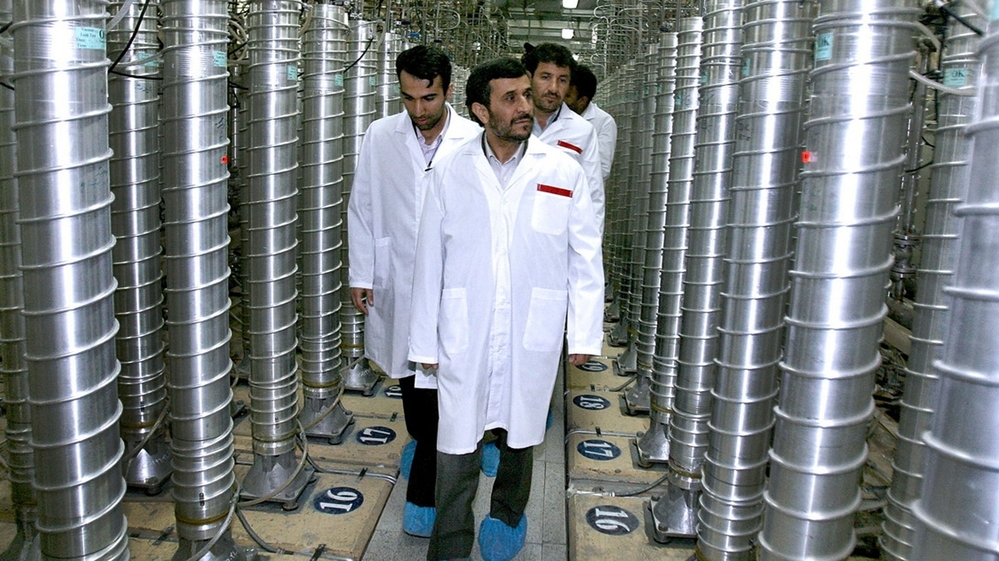
Iranian President Mahmoud Ahmadinejad (center) visits a uranium enrichment facility in Natanz, Iran, in 2008. Enriching uranium requires many fast-spinning centrifuges, arranged in what's called a cascade.
Iranian President's Office/AP Iranian President Mahmoud Ahmadinejad (center) visits a uranium enrichment facility in Natanz, Iran, in 2008. Enriching uranium requires many fast-spinning centrifuges, arranged in what's called a cascade.Iranian President's Office/AP
Iran's government on Thursday made clear it has no interest in direct talks until the U.S. eases sanctions that have been squeezing Iran's economy. But the Obama administration isn't budging and says the ball is in the Iranians' court.
The suspicion that Iran wants to make a nuclear weapon is the rationale for the sanctions as well as for veiled threats of U.S. or Israeli military action if those sanctions fail.
Iran's perceived nuclear aspirations are also the subject of a global effort that keeps popping up in the news: the game of "nuclear keep-away" to keep Iran from buying or manufacturing centrifuges, the machines that make uranium suitable for a bomb.
"We call it the long pole in the tent," physicist David Albright, a former United Nations weapons inspector, tells All Things Considered host Robert Siegel. "Getting the wherewithal to make the weapon-grade uranium or the separated plutonium is harder than learning how and assembling everything you need to know to make the nuclear weapon itself."
Separate Your Isotopes
Most uranium is useless for nuclear fuel or weapons. Less than 1 percent of it is the light, radioactive isotope uranium-235 that's used for power plants and bombs.
 Iranian President Mahmoud Ahmadinejad (center) visits a uranium enrichment facility in Natanz, Iran, in 2008. Enriching uranium requires many fast-spinning centrifuges, arranged in what's called a cascade.Iranian President's Office/AP
No comments:
Post a Comment